
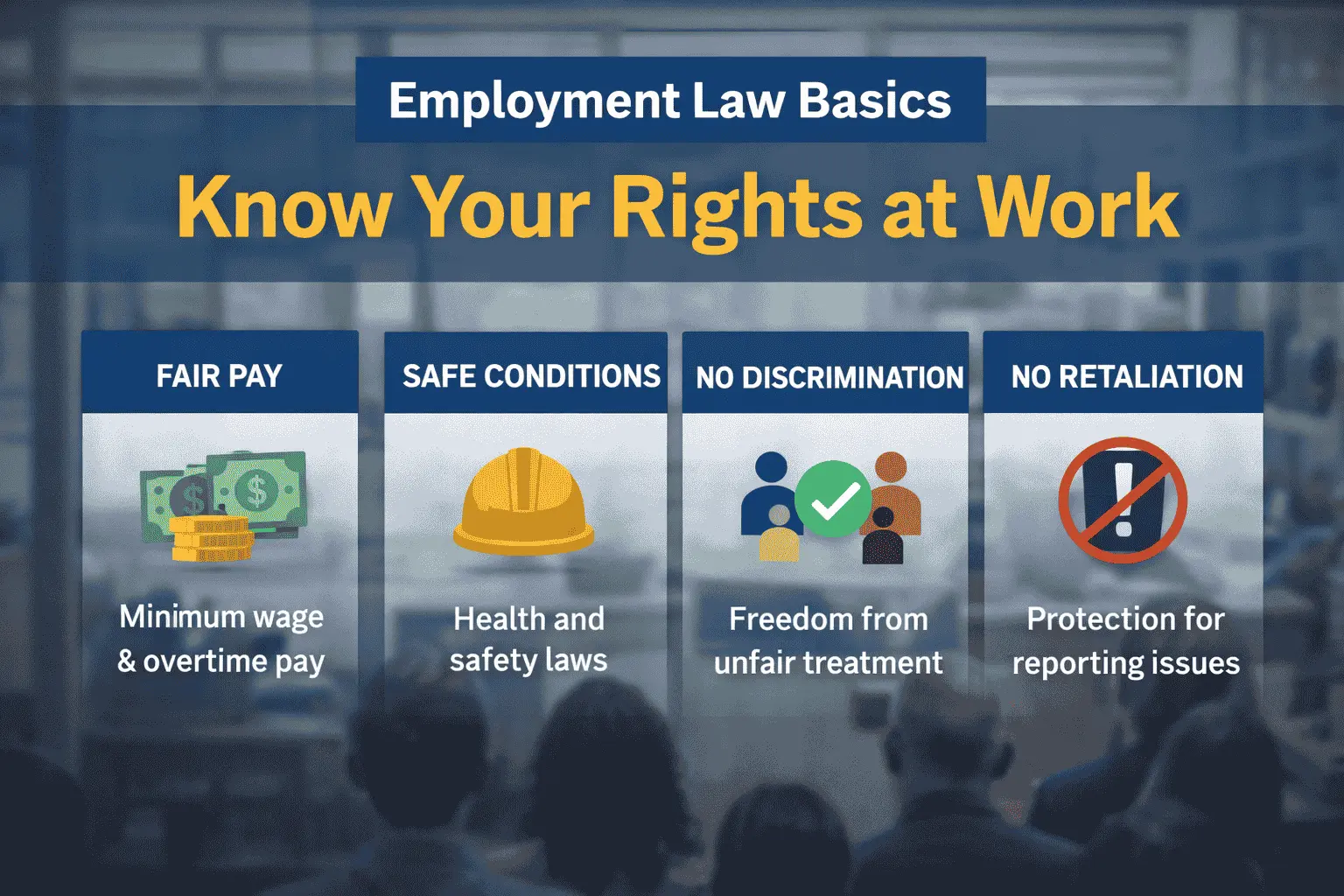
Employment Law Basics: Know Your Rights at Work
Most employees have no idea what the law actually requires their employer to do. Federal employment law gives you the right to fair pay, a safe workplace, and protection from discrimination and retaliation. These rights exist right now, whether your employer tells you about them or not.
What Are Your Basic Rights as an Employee in the USA?
Federal law gives every covered worker four core protections: the right to fair pay, the right to a safe workplace, the right to be free from discrimination, and the right not to be punished for speaking up. These rights apply to most workers in the United States, regardless of immigration status or job type.
The four rights, simply put:
- Fair pay: You are owed at least minimum wage and overtime for hours beyond 40 per week.
- Safe conditions: Your employer must follow OSHA health and safety rules.
- No discrimination: You cannot be treated unfairly because of your race, sex, age, religion, or disability.
- No retaliation: If you report a violation, your employer cannot legally punish you for it.
Knowing these four protections is where everything starts. Read more: Know Your Rights Before You Need a Lawyer
What Is the Fair Labor Standards Act and What Does It Cover?
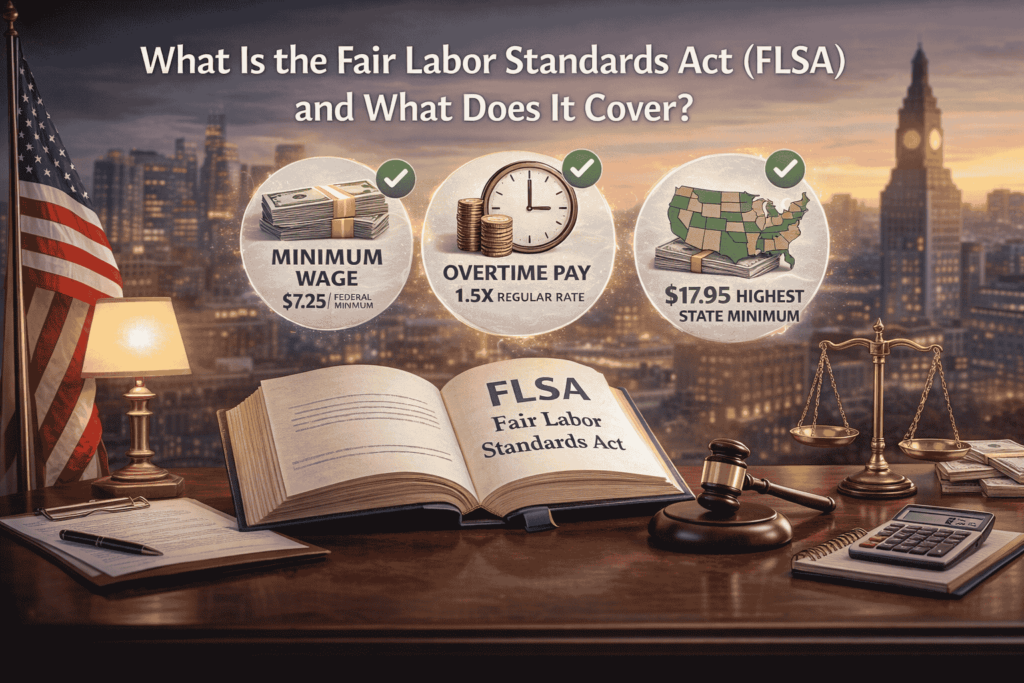
The Fair Labor Standards Act (FLSA) is the federal law that sets your right to minimum wage and overtime pay. It requires that most workers be paid at least $7.25 per hour and at least 1.5 times their regular rate for every hour worked beyond 40 in a single week.
The federal rate has not changed since 2009. But many states pay more. Washington, D.C. currently requires $17.95 per hour. Washington State requires $17.13. New York requires $17.00 in most major areas. Your employer must pay whichever rate is highest in your location.
Real scenario: Marcus worked 50 hours last week. His paycheck only showed 40 hours of regular pay. Under the FLSA, those 10 extra hours must be paid at 1.5 times his hourly rate. His employer has no legal right to skip that payment. Marcus can file a wage claim with his state labor board online for free.
If your employer owes you unpaid wages, you do not need a lawyer to start. The U.S. Department of Labor’s Wage and Hour Division accepts complaints at dol.gov.
What Is Wrongful Termination — and Was Your Firing Illegal?
Wrongful termination means your employer fired you for an illegal reason. Most U.S. states have at-will employment, which means your employer can fire you without giving a reason. But they cannot fire you for a reason the law forbids.
Firing is illegal when it is based on:
- Race, sex, age, religion, disability, or national origin
- Filing a complaint about discrimination or unsafe conditions
- Taking FMLA leave for a medical or family reason
- Jury duty or military service
- Whistleblowing on illegal activity
Real scenario: Diana reported a safety violation to OSHA on a Monday. She was let go on Friday. Her employer called it a performance issue. That timing is not a coincidence. Firing someone for reporting a workplace violation is retaliation. Filing a retaliation complaint with the EEOC costs nothing and takes under 30 minutes online.
Workplace Discrimination — What the Law Actually Protects
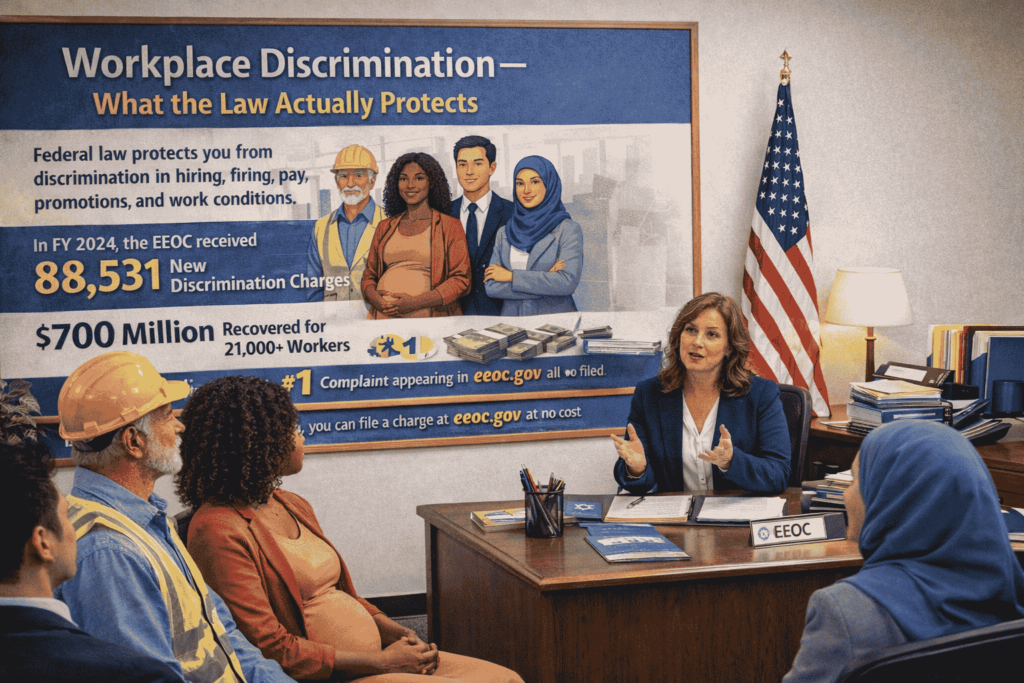
Federal anti-discrimination law protects you from unfair treatment in hiring, firing, pay, promotions, and daily work conditions because of who you are. The Equal Employment Opportunity Commission (EEOC) enforces these protections for workers across the country.
In FY 2024, the EEOC received 88,531 new discrimination charges, a 9% increase over the prior year. The agency recovered nearly $700 million for over 21,000 workers that year alone, the highest recovery in its recent history. Retaliation was the single most common complaint, appearing in nearly 48% of all charges filed.
Protected categories under federal law include race, color, sex, pregnancy, religion, national origin, age (40 and older), and disability. If you believe you have been treated unfairly because of any of these, you can file a charge at eeoc.gov at no cost.
What Is FMLA and Do You Qualify?
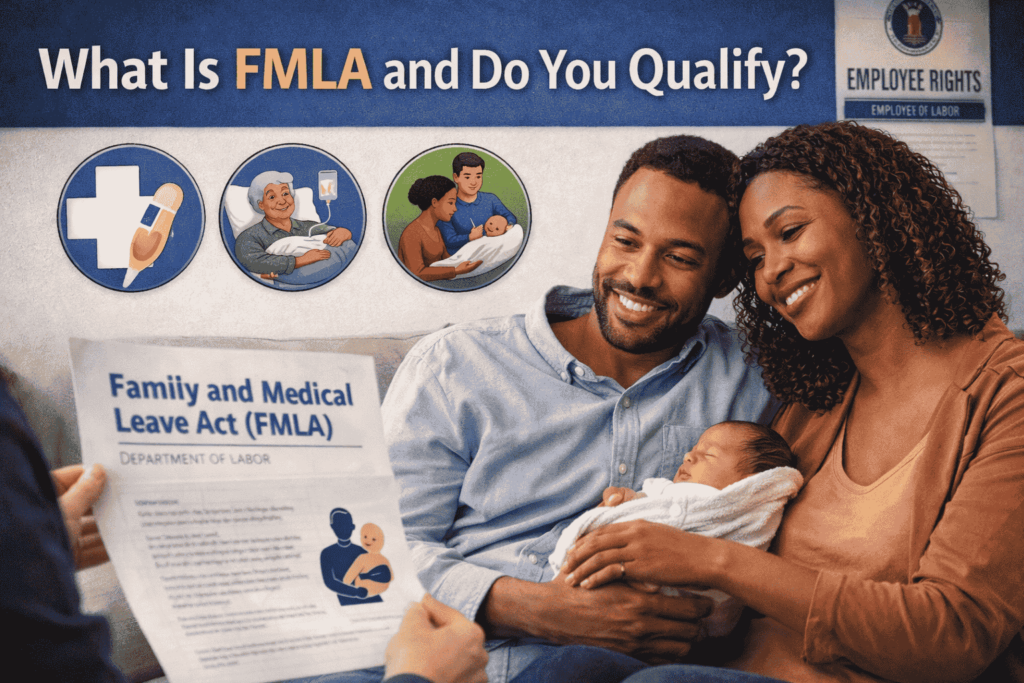
The Family and Medical Leave Act (FMLA) gives eligible employees the right to take up to 12 weeks of unpaid, job-protected leave per year for qualifying medical or family reasons. Your job must be waiting for you when you return.
To qualify, your employer must have 50 or more employees, and you must have worked there for at least 12 months and logged at least 1,250 hours in that time.
Qualifying reasons include a serious personal illness, caring for a sick family member, or the birth or adoption of a child. Your employer cannot fire you, demote you, or cut your pay for taking FMLA leave. If they do, that is a federal violation. You can file a complaint directly with the U.S. Department of Labor.
How to File a Workplace Complaint Without a Lawyer
You do not need an attorney to protect your rights at work. Three free options cover most situations.
- State labor board: Handles unpaid wages, overtime violations, and final paycheck disputes. Most states let you file online in under 30 minutes. The board investigates and recovers wages on your behalf at no cost.
- EEOC: Handles discrimination, harassment, and retaliation. File at eeoc.gov. The process is free and begins with an intake interview. Filing a charge also protects your right to sue later if needed.
- OSHA: Handles unsafe working conditions. File at osha.gov. Retaliation for an OSHA complaint is itself a federal violation. OSHA investigates and can order your employer to reinstate you and pay back wages.
Filing a complaint does not require a lawyer. Starting early always helps. Find free legal help near you
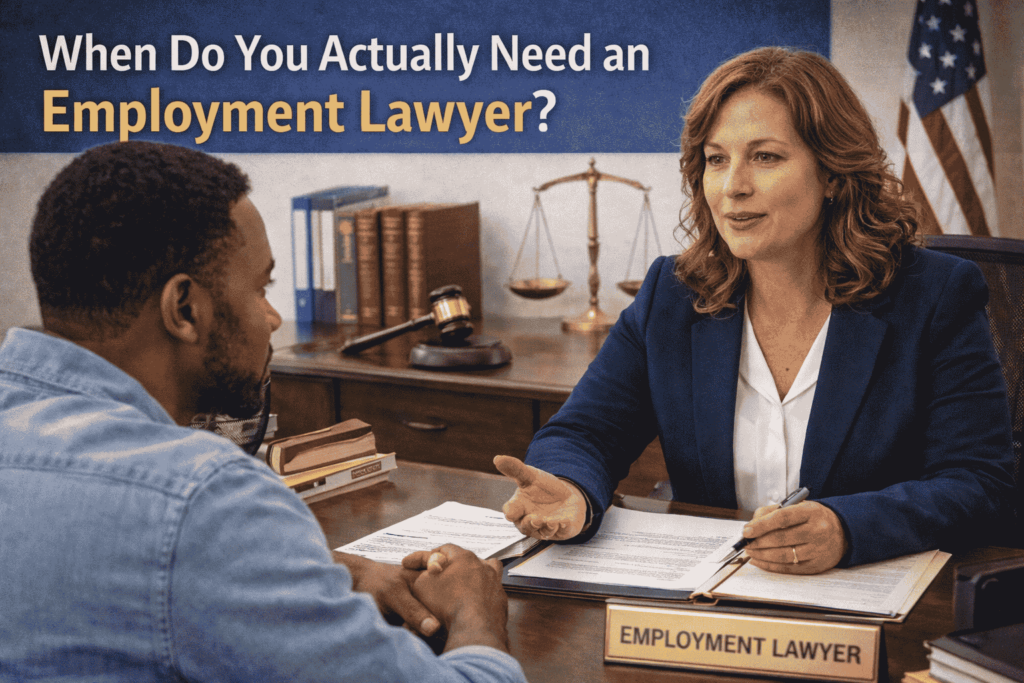
When Do You Actually Need an Employment Lawyer?
Many workplace issues can be handled without a lawyer. But some situations genuinely need one. Get a lawyer when large damages are involved, when your employer already has legal representation, or when you are facing a complex discrimination case.
The good news is that most employment lawyers work on contingency. That means you pay nothing upfront. They take 30 to 40% of what you recover, only if you win. A first consultation is almost always free.
If you are not sure whether your situation needs legal help, start with a free consultation. One conversation is usually enough to know.
Your Next Step
You have rights at work. You now know what they are and how to use them. The first step in almost every situation is simpler than it looks. File the complaint, call the agency, or book the free consultation. Every dollar recovered for workers last year started with someone who decided to take that first step. Start there.