
Know Your Rights Before You Need a Lawyer
Knowledge of your legal rights is not limited to courtrooms. It helps you make better decisions in daily life, from signing agreements to dealing with authority.
Read the Full Guide ↓Key Takeaways
- You have legal rights at work, at home, and with police that most people never use
- Knowing your rights can stop a small problem from becoming an expensive case
- Many situations can be handled without a lawyer if you know the right steps
- Free legal help is available in almost every U.S. state
- Legal information is free for everyone
- Legal advice requires a licensed attorney
Table of Contents
What Are Legal Advice Basics and Why Do They Matter?
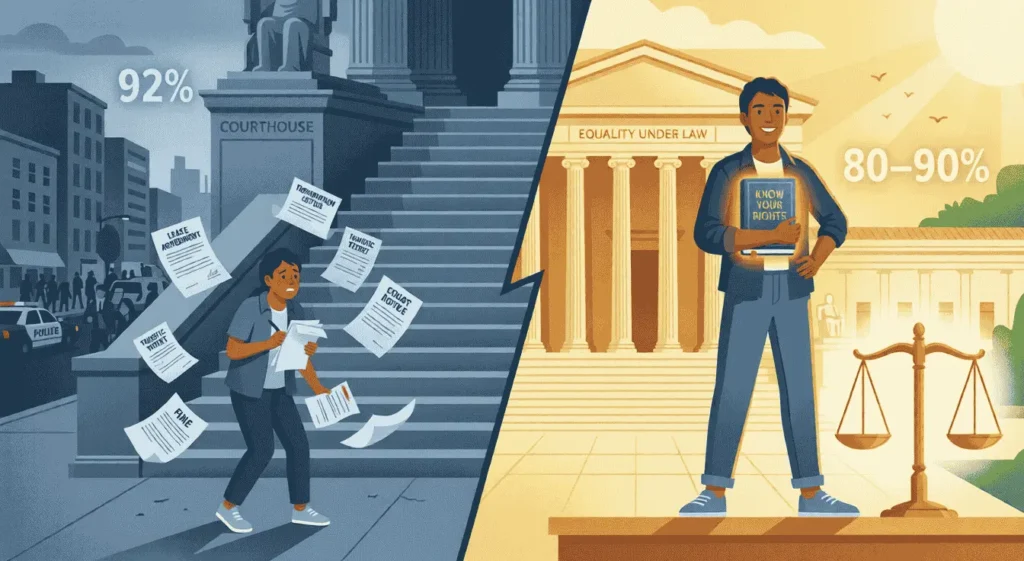
Legal advice basics are the foundational rights and rules that protect ordinary people in everyday situations. They apply when you sign a lease, get fired, shop online, or get pulled over. You do not need a lawsuit for these rights to matter. According to the Legal Services Corporation, 92% of civil legal problems faced by low-income Americans receive little or no help.
Studies of U.S. federal courts show that unrepresented parties lose 80 to 90% of the time. Cases with proper legal knowledge on both sides perform far more effectively. That gap is not about money. It is almost always about knowledge.
Most people only find out about tenant rights after they have already been illegally evicted. Most employees only learn about wrongful termination after they have already lost their job. You are reading this now, before something has gone wrong. That already puts you ahead of most people.
Legal Information vs Legal Advice
Legal information explains the law in general terms and is available to everyone. Legal advice is when a licensed attorney applies the law to your specific situation. Only a licensed attorney can give legal advice.
Understanding this difference is the first step to getting the right kind of help at the right time.
Main Areas of Law That Affect Everyday People
Most legal problems fall into one of five areas. Knowing which area applies to your situation helps you find the right help faster and ask better questions from the start.
Family Law
Covers marriage, divorce, child custody, child support, adoption, and domestic violence. These cases are personal and often need careful guidance
Criminal Law
Deals with offenses like theft, assault, or fraud. In criminal cases an attorney is essential. If you cannot afford one, the court must appoint one for you
Civil Law
Handles disputes between people or organizations. This includes contracts, personal injury claims, and benefits issues.
Employment Law
Protects workers’ rights including wages, fair treatment, workplace safety, and wrongful firing. If you face unfair treatment at work, this is your area.
Property Law
Covers buying and selling homes, renting, evictions, and foreclosure. Tenant disputes and deposit issues often qualify for free legal aid in most U.S. states.
Consumer Law
Protects you from false advertising, unauthorized charges, and defective products. You can file complaints without a lawyer.
Your Basic Rights at Work — What Most Employees Do Not Know
Your employer cannot fire you, underpay you, or put you in danger without legal consequences. Under the Fair Labor Standards Act, you are owed minimum wage and overtime pay for hours beyond 40 per week. OSHA requires safe working conditions. Federal law prohibits firing based on race, gender, age, religion, or disability.
If your employer fires you and refuses to pay your final paycheck, that is a legal violation. Your state labor board can take a complaint, investigate, and recover wages on your behalf with no lawyer required.
REAL-WORLD SCENARIO
Maria worked at a warehouse and was told she would not receive her last paycheck after being let go without warning. She did not need a lawyer. She filed a wage claim with her state labor board online in under 30 minutes. The board recovered her full paycheck within three weeks.
| Workplace Right | What It Means |
|---|---|
| Right to Fair Pay | Minimum wage and overtime required by law |
| Freedom from Discrimination | Protected based on race, sex, age, religion, disability |
| Right to a Safe Workplace | Employers must follow OSHA health and safety rules |
| Protection from Retaliation | Cannot be punished for reporting illegal acts |
| Reasonable Accommodations | Adjustments required for medical or religious needs |
Tenant Rights — What Your Landlord Cannot Legally Do
Your landlord must keep your home safe, give you proper notice before entering, and follow a legal process before any eviction. They cannot change your locks, cut your utilities, or remove your belongings to force you out. That is self-help eviction and it is illegal in every state. If they keep your deposit without proof of damage, you can sue in small claims court.
If your landlord keeps your deposit without proof of damage, you can sue in small claims court. In many states a landlord who wrongfully withholds a deposit owes you double or even triple the amount.
REAL-WORLD SCENARIO
James came home to find his landlord had changed the locks after a rent dispute. James had not received any court notice. He called his local legal aid office that afternoon. Within 48 hours, a judge ordered the landlord to restore access and pay James damages under state self-help eviction law.
| State | Days to Return Security Deposit |
|---|---|
| New York | 14 Days |
| California | 21 Days |
| Florida | 15 to 60 Days |
| Texas | 30 Days |
| Indiana | 45 Days |
| Oregon | 31 Days |
Your Rights When Police Stop or Question You
You have the right to remain silent, the right to refuse a search, and the right to an attorney if arrested. These rights apply to everyone in the United States. You do not have to answer questions about where you are going or what you have been doing. Knowing exactly what to say keeps a difficult stop from becoming something worse.
Simply say: “I am exercising my right to remain silent.” If police ask to search your car or home, say: “I do not consent to a search.” If arrested, say immediately: “I want a lawyer.” If you cannot afford one, the court must provide one.
| Situation | What to Say or Do |
|---|---|
| Police Questioning | “I wish to remain silent.” |
| Search Request | “I do not consent to a search.” |
| Street Stop | “Am I free to go?” |
| Arrest | “I want a lawyer.” |
| In a Car | Hands on wheel, stay calm |
Consumer Rights — When a Business Cheats You
You have the right to accurate advertising, a refund for defective products, and protection against unauthorized charges. Federal law through the FTC prohibits deceptive business practices.
If a company charged you for something you did not agree to, dispute it with your bank through a chargeback or file a complaint at reportfraud.ftc.gov. No lawyer needed for either step.
Important Types of Legal Guidance You Should Know
Not all legal help looks the same. Knowing which type fits your situation helps you get the right help at the right time and often saves you serious money.
Preventive Legal Guidance
This helps you spot risks before they become expensive problems. It covers reviewing contracts before signing, setting up a will, and making sure agreements are fair. One early consultation can prevent years of trouble.
Transactional Legal Guidance
This is what you need when buying real estate or entering any major financial agreement. A lawyer reviews the fine print and catches risky clauses before you commit.
Litigation Help
This guides you through the court process when a dispute cannot be resolved outside a courtroom. It covers gathering evidence and presenting your case before a judge.
How Much Does It Cost to Sue Someone?
Filing fees in civil court typically run between $50 and $500 depending on your state. Attorney hourly rates run between $150 and $500 per hour. Contingency fee arrangements mean you pay nothing upfront. The attorney takes 33% to 40% only if you win. For smaller disputes, small claims court filing fees are usually under $100 with no lawyer required.
For smaller disputes, small claims court filing fees are usually under $100 with no lawyer required.
| Cost Type | Small Claims Court | General Civil Court |
|---|---|---|
| Filing Fee | $30 to $100 | $200 to $600 |
| Attorney Fees | $0 (Self-represented) | $150 to $500 per hour |
| Service of Papers | $50 to $100 | $50 to $300 |
| Expert Witnesses | Not typically used | $100 to $600 per hour |
| Mediation | Often Free | $200 to $1,000 |
When Can You Handle It Yourself vs. When to Get a Lawyer?
Many everyday legal situations do not need an attorney. Small money disputes, billing errors, and filing a complaint with a government agency are things most people handle alone. You need a lawyer when criminal charges are involved, when significant money is at stake, or when the other side already has legal representation.
| Handle It Yourself | Get a Lawyer |
|---|---|
| Small money disputes under $5,000 | Serious injury or high medical bills |
| Billing errors with phone or cable company | Facing criminal charges or jail time |
| Getting a security deposit back | Complex divorce with many assets |
| Simple name changes or basic wills | Being sued for a large amount |
| Filing a report about a scam or fraud | Situations involving complex business law |
A free consultation is almost always worth doing before you decide. One conversation can tell you everything you need to know about whether you need help.
Who Is a Plaintiff and Who Is a Defendant?
A plaintiff is the person who files a lawsuit and claims they were harmed. A defendant is the person being sued and must respond to that claim. In a car accident case, the injured person who files is the plaintiff. The driver being sued is the defendant.
Legal counsel simply means a lawyer who advises and represents you. Seeking legal counsel means talking to an attorney. You are under no obligation to hire them after that first conversation.

How to Prepare for a Lawyer Consultation
Walking into any consultation prepared means you get better advice in less time. Most people waste the first 20 minutes of a paid consultation explaining basic background that they could have organized in advance.
Define your issue and desired outcome in writing before the meeting. Gather contracts, emails, letters, and a timeline of events. Then come with these questions ready:
| Question to Ask | Why It Matters |
|---|---|
| What are my legal options in this situation? | Gives you a clear picture of all paths available |
| How much time do I have to act? | Deadlines in law are strict and often irreversible |
| Are there alternatives to going to court? | Mediation or settlement can save months and money |
| What evidence will strengthen my position? | Tells you exactly what to gather before next steps |
Should You Get Legal Advice from Reddit or Social Media?
Online forums and social platforms may point you in a general direction, but they cannot replace qualified legal guidance. Posts come from strangers with no accountability, no knowledge of your state’s laws, and no stake in whether your outcome is good or bad. What worked for someone in Texas may be completely wrong for someone in New York.

How to Find Free or Low-Cost Legal Help
Free legal help exists for people at almost every income level in the United States. Legal aid organizations funded by the Legal Services Corporation handle housing, family law, domestic violence, benefits, and consumer cases. Law school clinics provide free help from students supervised by licensed attorneys. The ABA Free Legal Answers platform connects eligible users with volunteer attorneys at no cost.
Legal Services Corporation
Funds civil legal aid across all states. Find local offices at lsc.gov.
LawHelp.org
Self-help forms and legal information organized by state and issue type.
ABA Free Legal Answers
Submit civil legal questions and get answers from volunteer attorneys at no cost.
University Law Clinics
Law students supervised by licensed attorneys handle real cases for free.
State Bar Associations
Pro bono lawyer referral programs available in every state. First consult often free.
Legal Aid Society
Provides free civil legal services to low-income individuals and families across the U.S.
The 5 Core Principles That Underpin Your Rights
These five principles are why your legal rights exist. They apply equally to everyone regardless of income, background, or status. Understanding them helps you see the legal system not as something working against you but as a structure built to protect you.
| Principle | What It Means for You |
|---|---|
| Accountability | The law applies to everyone including landlords, employers, and police |
| Just Laws | Laws must be fair, clear, and protect basic human rights |
| Open Government | Legal processes must be publicly known and accessible |
| Impartial Justice | Judges decide based on facts and law, not politics or money |
| Separation of Powers | No single person or institution holds all legal authority |
Building Confidence Through Legal Knowledge
Legal knowledge changes how you carry yourself. You stop feeling like legal situations are things that happen to you. You start seeing them as situations you can navigate with the right information.
You recognize unfair treatment faster. You know when to push back and when to get help. You ask better questions and make better decisions.
Most people who handle legal situations on their own are not legal experts. They are simply people who took the time to get informed before the problem got bigger. You have just done that. If a situation does come up, start with the relevant section of this guide, take the free consultation, and make the call to a legal aid office. The first step is almost always simpler than it looks.
This content is for general informational purposes only. It is not legal advice and does not create an attorney-client relationship. For guidance specific to your situation, please consult a licensed attorney in your state.
Written and maintained by Daniel Brooks, legal researcher · Content reviewed by a licensed U.S. attorney